


Mental health is increasingly recognised as one of the defining challenges of our time. Post-COVID, many have called it the next biggest health crisis. For children growing up in communities where stress, instability, and hardship are part of daily life, mental health struggles are often a reality.
Yet alongside this is a more hopeful shift: conversations are opening up, stigma is lifting, and caregivers and educators are becoming better equipped to respond with understanding.
In schools, this awareness is critical. For many children, emotional distress does not present as something easily named, but shows up in behaviour, withdrawal, or ways that are often misunderstood.
“Trauma is not always a single event but often continuous,” explains social worker for The Love Trust, Elsie Lekana. The Love Trust is a faith-based non-profit organisation which runs Nokuphila School for disadvantaged learners in Thembisa. Elsie balances the effects of ongoing trauma by applauding many of those affected, saying, “Although children can be deeply vulnerable to harm, neglect, and poverty, they also have a remarkable capacity for resilience and adaptation.”
This dual reality sits at the heart of a more constructive approach to mental health. Rather than defining children by what has happened to them, the focus shifts to how they can be equipped to cope, recover, and grow.
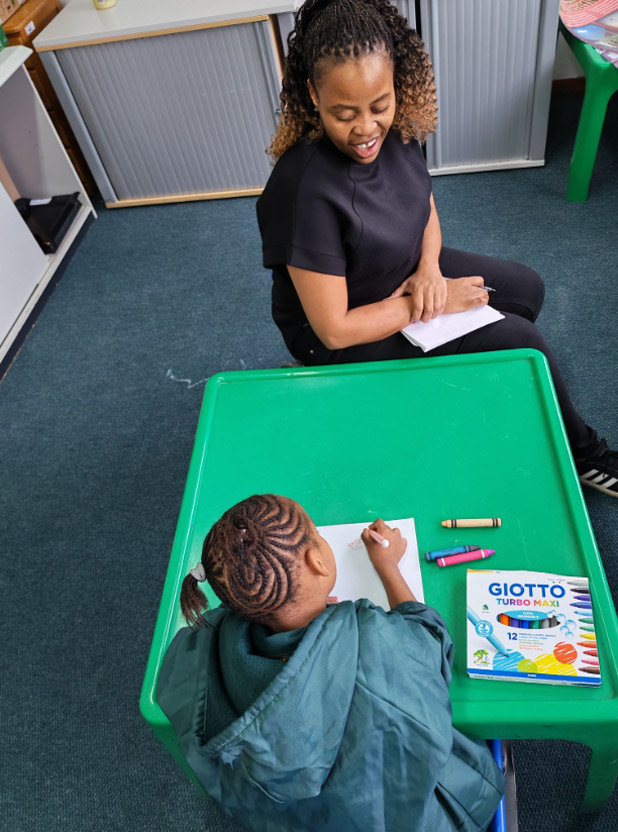
Social worker, Elsie Lekana, with a learner.
Recognising what isn’t always obvious
One of the biggest challenges for caregivers and teachers is that trauma does not always look like distress. It can be subtle, and in a busy classroom, easily misread.
Children may become aggressive or clash with peers. Others withdraw, avoid participation, or seem disinterested. Difficulty concentrating, inability to engage with schoolwork, anxiety, or low self-esteem are also common indicators. In some cases, physical signs such as neglect of personal care may point to deeper emotional strain.
Working closely with Elsie is psychology student Dineo Nobunto, who notes, “One common misconception is that children are ‘too young to remember’ or that they will simply ‘grow out of’ traumatic experiences. In reality, trauma affects children deeply, even when they cannot fully verbalise it.”
Shifting the mindset from “What is wrong with this child?” to “What might this child have experienced?” can fundamentally change how adults respond.
Creating spaces where children feel safe
Both home and school environments play a powerful role in shaping a child’s sense of safety. Small, consistent actions often matter more than grand interventions.
At home, emotional availability, predictable routines, and calm communication help build trust. In the classroom, inclusive spaces, fair discipline, and attentive teachers create stability. “These everyday interactions build a sense of stability and trust, which are essential for healing and resilience,” says Dineo.
Simple behaviours like listening, validating feelings, and keeping promises signal to children that they are seen and supported.

Psychology student, Dineo Nobunto, with a learner.
Online dashboard: ushering in the new era of self-regulated learning
Anne Moens, a Master’s student in Training and Educational Science at the University of Antwerp, joined forces with The Love Trust as a research intern to design the online dashboard, the new measurement tool.
The problem was clear: there was no unified platform enabling interns to evaluate their professional development over time. Motivation sometimes dipped after placement, and feedback was not always tracked. Moens’s passion for both teaching and technology collided perfectly within the dashboard development. “The dashboard empowers interns to track their growth. It builds reflective, self-regulated teachers who stay motivated beyond their internship.”
The dashboard introduces:
- Bi-weekly structured self-evaluations
- Mentor feedback aligned to professional competencies
- Visual tracking of growth over time
- Gap analysis between current performance and desired goals
The aim is not surveillance but a cohesive approach to ensuring data and feedback with the integrity to support a self-disciplined approach to teacher and mentor development. Firmly structured self-evaluation builds planning skills, critical thinking, discipline, and resilience, essential traits for teachers serving complex communities, particularly in the face of a looming teacher shortage.
A model for systemic change
The Love Trust’s broader ecosystem strengthens this initiative. Nokuphila School maintains near-perfect pass rates, supported by a robust school-based support team and partnerships with the University of Johannesburg and SACAP psychology departments. Over 120 learners received counselling support in 2025 alone.
This culture of accountability and early intervention extends naturally to teacher formation. Looking ahead, the internship hopes to position The Love Trust as a recognised example in pre-service teacher development and serve as a scalable framework for other schools.
In addressing South Africa’s teacher shortage, The Love Trust is not waiting for systemic reform. It is modelling it. Tomorrow’s teachers are not simply being trained. They are being intentionally developed within a system designed to measure, mentor, and multiply impact.
Responding with care, not judgement
When signs of distress do emerge, the response from adults can either support healing or deepen isolation.
“I encourage curiosity rather than judgment,” says Elsie. Instead of reacting with frustration, she suggests gentle observations such as, “I noticed you seemed upset today. Do you want to talk about it?”
This approach allows children to feel acknowledged without pressure and avoids forcing disclosure before they are ready.
A practical starting point for caregivers
Children do not always have the words to express what they are going through. Look out for changes in their behaviour, emotions or physical appearance:
Behavioural signs
- Increased aggression
- Withdrawal from friends or activities
- Avoidance of schoolwork or declining performance
- Appearing disengaged
Emotional signs
- Ongoing fearfulness or excessive worry
- Low self-esteem
- Heightened sensitivity or emotional outbursts
- A sense of isolation
Physical and care-related signs
- Changes in sleep or constant fatigue
- Poor hygiene
- Frequent unexplained aches and pains
These signs do not always indicate trauma, but they may signal a need for support. What matters most is responding with curiosity, care, and consistency.
For caregivers, small, intentional actions can make a meaningful difference:
- Create safe, non-judgemental spaces
- Respond calmly rather than reactively
- Validate feelings
- Maintain routines
- Prioritise connection
- Seek support early
- Protect the child’s dignity
Supporting children in trauma-affected communities is not about having all the answers, but about showing up with empathy and consistency.
With the right tools, caregivers and educators can more easily recognise distress and respond in ways that restore a child’s sense of safety, dignity, and hope.